


What is an AI agent, and how does it differ from a chatbot?
These days, whenever artificial intelligence is discussed, two terms frequently come up: “chatbot” and “AI agent.” Many business owners—whether running a company or a private practice—get stuck at precisely this point when looking to develop an intelligent solution: they do not know the difference between these two concepts or which one actually suits their needs.
This question is not without reason. Both tools interact via text, both provide answers to questions, and at first glance, they appear similar. However, beneath this superficial resemblance lies a fundamental difference in architecture and capabilities—one that directly impacts your purchasing decision, costs, and the results you achieve.
In this article, we explain—precisely and without unnecessary complexity—what an AI agent is, what a chatbot is, how they differ, and, most importantly, which one makes more sense for your business.
Stay with Holly Tech until the end of this article…
What exactly are AI agents and chatbots?
How does a chatbot work?
A chatbot is a system that receives your message, retrieves relevant information from a knowledge base—technically referred to as RAG (Retrieval-Augmented Generation)—if necessary, and returns a text-based response. The key point is this: the chatbot merely provides an answer. If it states, “Three tasks need to be performed for you,” it does not actually carry out any of those tasks itself; it simply explains the situation and waits for your next message.
How an AI agent works
An AI agent enters a cycle known in the technical world as the observe-reason-act loop. This loop consists of four stages that repeat sequentially and continuously:
The first stage is observing the current state—meaning the agent sees what is happening right now. The second stage is reasoning—determining the logical next step. The third stage is action—actually performing a task, such as invoking a tool, updating a record in your system, or sending an SMS. The fourth stage involves observing the result of that action and restarting the cycle. This process repeats until the task is completed.
An important point to understand is that the language model powering a chatbot and an agent can be exactly the same. The key difference isn’t the model itself; rather, it lies in what is built around it: access to tools, a memory that tracks the workflow across different stages, and a coordination layer that determines the next step.
A tangible example
Imagine a customer sends a message requesting a refund. A standard chatbot typically operates on simple “if-then” logic: if the customer mentions “refund,” it directs them to the FAQ page regarding refunds. An AI agent, however, takes a different approach: it reviews the customer’s order history, checks the company’s refund policy, determines eligibility, actually processes the refund in the system, and finally confirms with the customer that the task is complete—all without requiring human intervention.
Why this difference matters for your business
Cost and speed
Each time an agent enters the cycle of thinking, acting, and re-thinking, the language model is invoked multiple times. This results in higher costs and longer response times compared to a chatbot that simply provides a single answer. For simple questions like “What are your business hours?”, there is no reason to incur this added complexity.
Operational risk
An AI agent takes real action: it issues refunds, sends emails, books appointments, or deletes records. If it makes a wrong decision, that error has a tangible impact on your business. A chatbot merely talks; if it errs, the worst-case scenario is simply providing an incorrect answer, rather than an erroneous action being logged in your system.
Where do you really need artificial intelligence, and where don’t you?
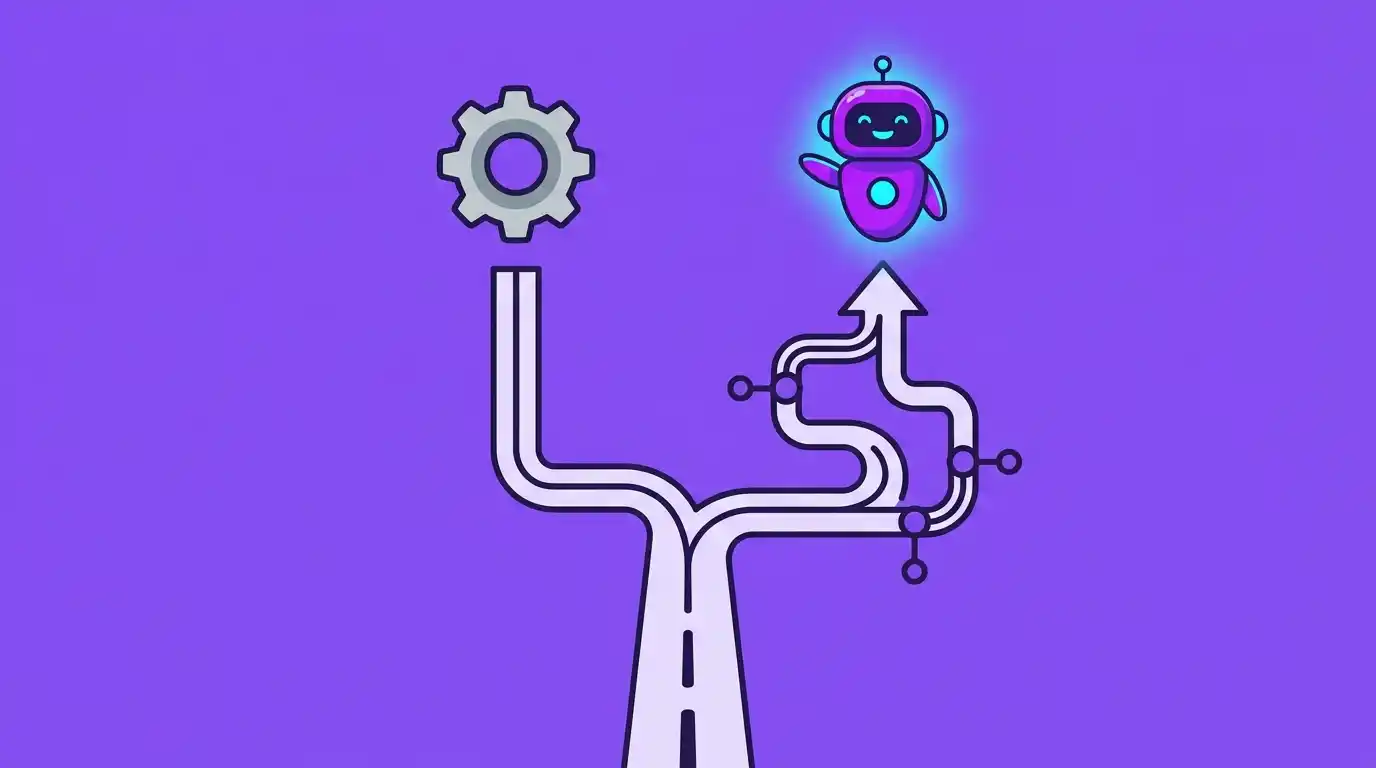
A common misconception is that the more we strip away the “thinking” component from artificial intelligence, the better—since the result is cheaper and less prone to error. While this holds some truth, it is not a universal rule. If a process is entirely fixed and predictable—meaning the same steps are always repeated in the same sequence—then simple automation (without AI) is the best option, as it is cheaper, faster, and more reliable.
However, many processes that appear static at first glance actually involve decision points requiring genuine judgment. For instance, if a clinic patient sends a message stating they cannot make their scheduled appointment, coordinating a new time that aligns with both the doctor’s schedule and the patient’s preferences involves countless variables; establishing a fixed rule to cover every scenario is practically impossible or prohibitively costly. This is precisely where an AI agent demonstrates its true value.
How to decide which option is right for our business
The first step is to put your intended process down on paper and determine what percentage of it is completely fixed and predictable, and what percentage requires real-time decision-making.
The second step is to handle the fixed parts of the process using simple automation tools rather than artificial intelligence; these components can be executed more cost-effectively and with fewer errors.
The third step is to use an AI agent only for genuine decision points—that is, situations where the path is not predetermined and semantic understanding is required.
The fourth step is to always include a human review point for sensitive actions (such as high-value refunds or contract cancellations), even if the agent operates automatically.
If you conduct this analysis yourself, you will likely find that a combination of both tools—simple automation for routine tasks and intelligent agents for decision points—yields the best results for your business.

HallyTech is by your side; we resolve all your business smart-integration concerns.
As we have seen in this article, determining whether your business requires simple automation or a genuine AI agent is a critical technical decision. At HollyTech, this is exactly where we begin: before making any recommendations, we analyze your actual business processes to identify which areas truly require AI and which can be addressed with simpler, more cost-effective solutions. In short, we do not impose unnecessary costs on you simply for the sake of using the term “Artificial Intelligence.”
Our team designs and implements dedicated AI agents that operate using your business’s actual systems and data—moving beyond generic, off-the-shelf solutions. From intelligent follow-ups and appointment scheduling to data analysis and internal process automation, we tailor every solution to your specific needs.
If you would like to know exactly which of these two solutions your business needs—and how to achieve the best results without incurring extra costs—contact HaliTech today. Our goal is your complete satisfaction, which is why we are constantly improving our services in terms of speed, pricing, and quality.
HaliTech Free Consultation Hotline: 09379887685
Frequently Asked Questions (FAQs)
1. Is an AI agent always better than a chatbot?
No. An agent is better for tasks requiring actual decision-making and action, but for simple questions and fixed workflows, a chatbot is cheaper, faster, and sufficient.
2. Is it possible to convert an existing chatbot into an agent?
Usually, not easily. A chatbot consists only of conversation and knowledge retrieval layers, whereas an agent requires additional layers—such as a coordinator, tool integration, and state management—that must be designed from scratch.
3. How much does it cost to build an AI agent for a small business?
The cost depends on the complexity of the process, the number of systems requiring integration, and the level of accuracy needed. The best approach is to have a team of experts review your process for free to obtain an accurate estimate.
4. Does using an AI agent pose a risk to my business?
Like any tool that performs actual actions, it does indeed carry risks; however, with proper design and the inclusion of human checkpoints for critical decisions, this risk can be significantly managed.
5. How do I know whether my business needs an agent or if simple automation is enough?
If your process always follows the exact same steps, simple automation suffices. If your process involves points requiring real-time judgment and decision-making, you need an AI agent.
Join Hali Tech right now…
Chatbots and AI agents are distinct tools with different use cases—they are not merely two versions of the same thing. A chatbot provides answers, whereas an agent takes action. The right choice between the two depends on the actual structure of your business processes, not on which one appears more “advanced.” Your next step is to examine your business processes, identify actual decision points, and determine where AI is needed versus where a simpler solution suffices. Contact us today.