


One of the first questions any business owner asks when considering the use of an AI agent is: “How much will it cost?” This is a perfectly logical question, yet answering it with a single, fixed figure is not only impossible but also misleading.
The reason is simple: the question of how much it costs to build an AI agent is exactly like asking how much it costs to construct a building. The answer depends entirely on whether the building is a small storage shed or a residential high-rise, the materials used, and the amenities included. AI agents are exactly the same.
In this article, rather than providing a misleading figure, we explain the specific factors that drive the final cost of building an AI agent for your business. By reading this article, you will gain a practical framework—far more valuable than a meaningless number—to understand and evaluate any proposal you receive. Stay with HollyTech until the end to clear up all your questions and uncertainties regarding the cost of developing an AI agent.
Stay tuned with HaliTech…

What factors determine the cost of building an AI agent?
There are two main factors that have the greatest impact on cost: the agent’s level of autonomy and the type of architecture selected for it. Let’s break each one down with examples.
Agent autonomy level
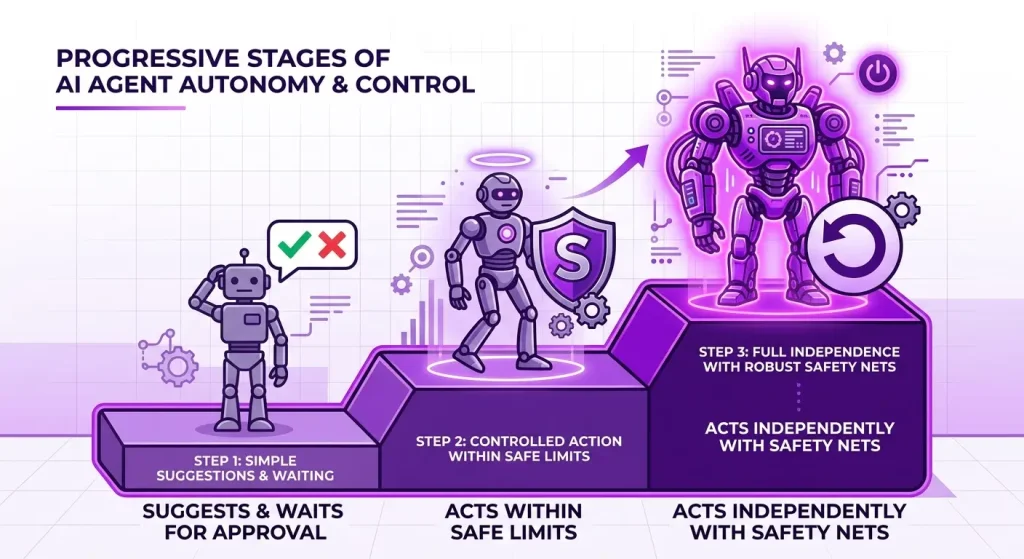
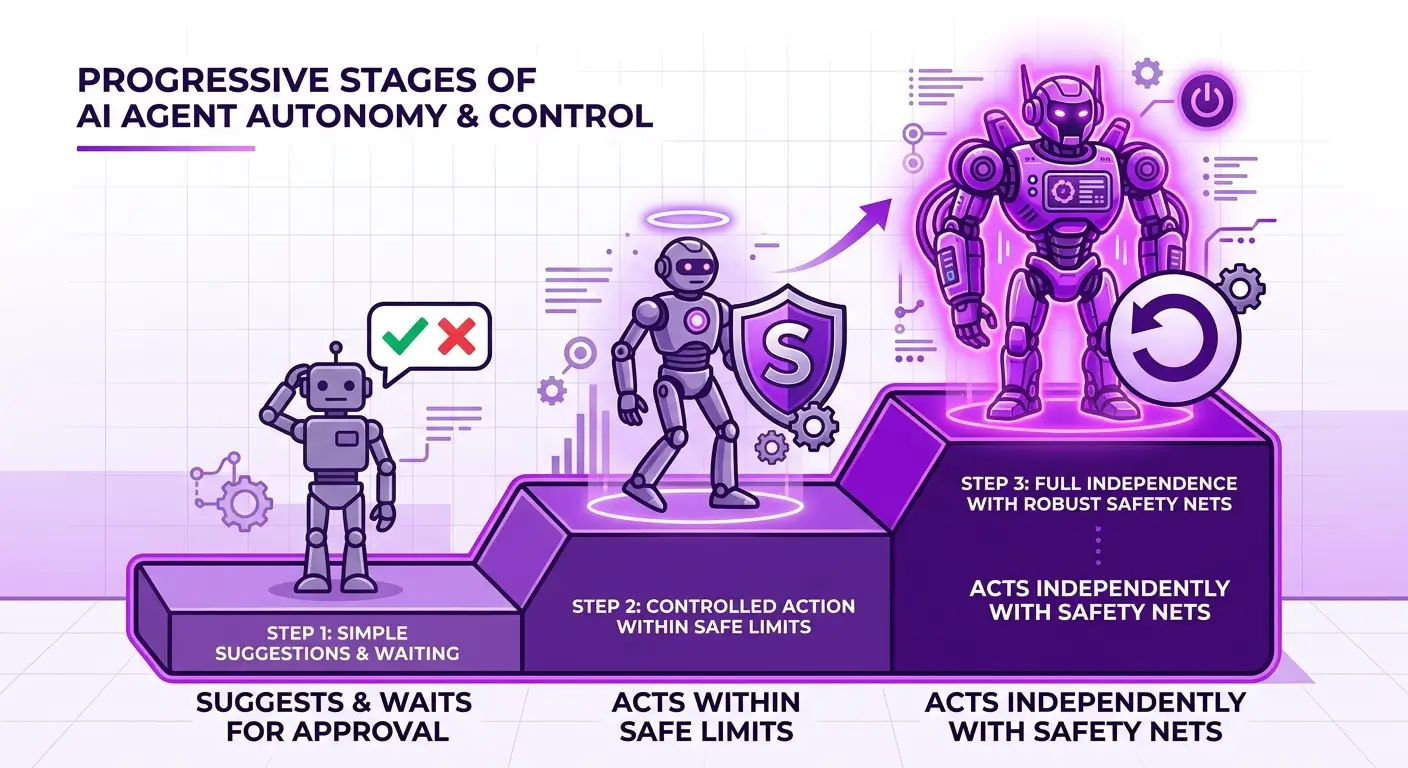
Autonomy refers to the extent to which an agent makes decisions and takes action on its own, without requiring human approval. As this level increases, both the agent’s capabilities and the complexity and cost of building it grow.
At the lowest level is an assistive agent. This type of agent merely makes suggestions and awaits human approval. For instance, when a patient requests to reschedule an appointment, the agent identifies several available time slots and presents them to the receptionist; the final decision rests with the human. Developing this type of agent is simpler because it never takes direct action on the actual system, so no harm is caused if it makes a mistake.
At the intermediate level, we find the semi-autonomous agent. This type of agent performs certain tasks independently—without human intervention—yet operates within specific rules and constraints. Implementation becomes more complex at this level, as you must precisely define which actions the agent is permitted to execute autonomously versus those requiring human approval; furthermore, you need to create a testing environment to simulate the agent’s actions prior to actual deployment.
At the highest level sits the fully autonomous agent, which makes decisions and takes action without requiring any approval. This level is both the most powerful and the most costly, as a recovery mechanism must be designed for every action the agent performs—meaning the system must be able to automatically rectify the error if the agent makes a mistake. Consequently, for every new capability you grant the agent, you must also build a corresponding recovery function, which significantly increases the engineering workload.
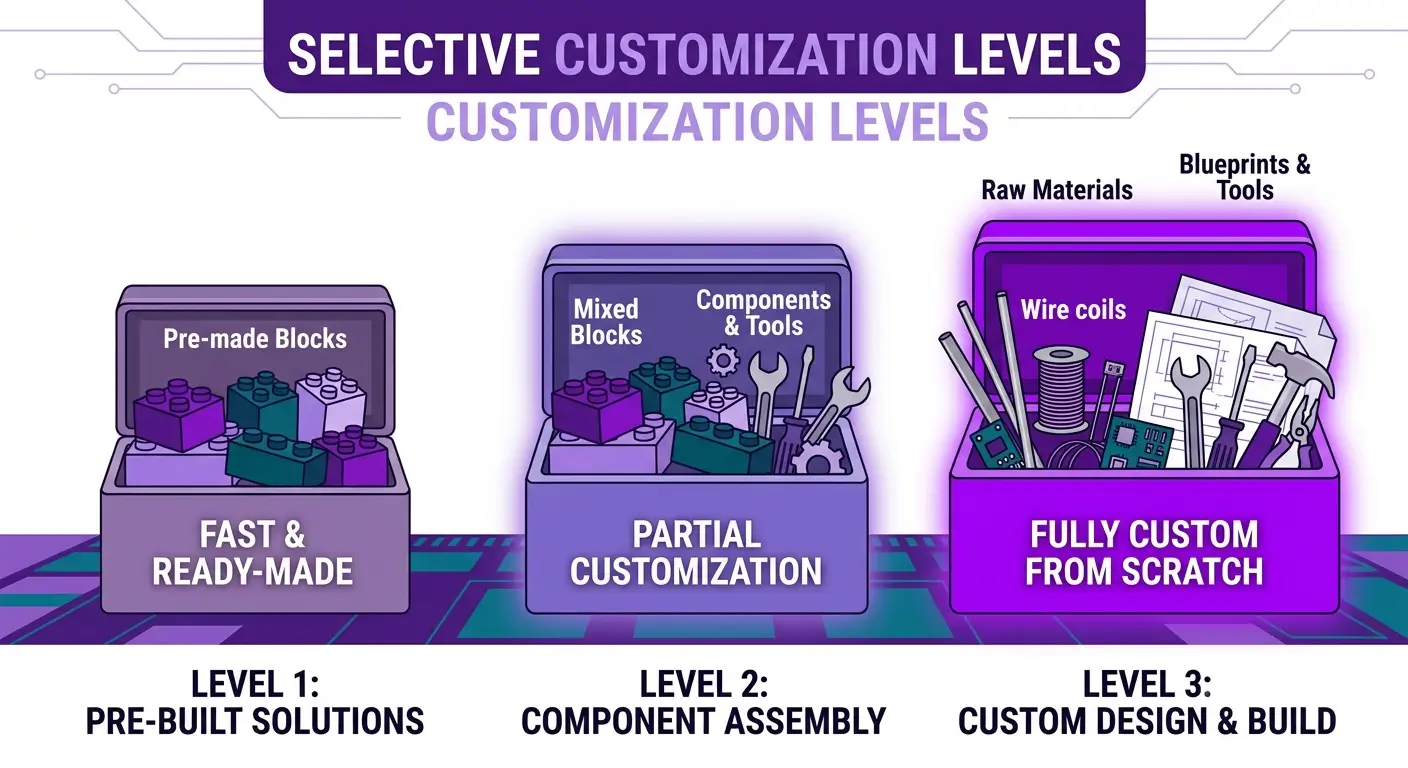
Development type: No-code, low-code, or fully custom.
A second important factor is the method by which the agent is created.
In the no-code approach, ready-made platforms like n8n are used; these come with pre-built components—such as a module for sending messages or one for checking a calendar. Like Lego bricks, these components are assembled without writing a single line of code. While this method is the fastest and most cost-effective, you face limitations when your requirements exceed the platform’s built-in capabilities.
In the low-code approach, the foundation is still built upon a ready-made framework, but the components specific to your business are implemented using actual code. For instance, if your laboratory requires specific rules for a particular type of test that are not covered by the platform’s pre-built components, that functionality is added through custom coding. This method strikes a balance between speed and customization.
In a fully custom approach, everything is designed and coded from scratch—without relying on any off-the-shelf platforms—or involves deeply customizing even the components of existing frameworks. This method is typically required when a business needs to connect the agent to its own proprietary, legacy internal systems for which no ready-made integration exists. While this approach offers the greatest control and flexibility, it also demands more time and engineering expertise.
Why do these differences affect the final cost?
The key point is that costs do not stem solely from the initial construction; a significant portion of the actual cost emerges continuously after the initial handover—and this is precisely the aspect that few people discuss at the outset.
Every time the agent “thinks”—that is, invokes the language model—it incurs a cost. The more complex the agent and the more decision-making cycles it undergoes, the higher this recurring monthly cost will be, independent of the initial development cost.
The system must run somewhere; this entails server hosting and infrastructure costs, which are recurring monthly expenses.
Before an agent can use your business data, it must be cleaned and made machine-readable. If your data is fragmented or incomplete—a common issue for many small businesses—this step can be as time-consuming and costly as building the model itself.
Your business needs do not remain static; therefore, the agent must be regularly maintained and updated to stay aligned with changing conditions.
You need to know where the agent performs well and where it does not; this requires continuous monitoring and analysis tools, which also entail ongoing costs.
Ultimately, if the system fails or data becomes corrupted, you must be able to recover it; this necessitates a separate backup infrastructure.
How should you view this matter?
The best approach is to divide the cost of building an AI agent into two completely separate components: the initial development cost and the ongoing maintenance cost.
The first step is to determine the actual level of autonomy you need. Many businesses think they should jump straight to the most comprehensive and autonomous version, whereas an assistive or semi-autonomous agent often delivers the same result with significantly lower cost and risk.
The second step is to determine whether your actual needs can be met using no-code or low-code tools, or if you truly require deep integration with specific legacy systems—something that would justify custom development.
The third step is to factor ongoing costs—namely, language model usage, hosting, maintenance, and monitoring—into your calculations from the very beginning, rather than focusing solely on the initial development costs.
The fourth step is to ask whichever team you are working with to specify exactly these factors for you, rather than simply providing a final figure without explaining where that number came from.
HaliTech is with you; we make the costs you pay transparent and reasonable.
As you have seen in this article, the cost of building an AI agent depends on dozens of factors, each of which can significantly alter the final price. At HaliTech, rather than providing a predetermined figure, we start right here: before discussing costs, we analyze your actual business systems and data to determine exactly what level of autonomy and type of build you require.
We will build the initial version of the solution for you completely free of charge, without asking for any payment before you see actual results. We will only discuss continuing our collaboration and covering ongoing costs once the solution has delivered real value to you.
If you want to know exactly what type of AI agent your business needs and what the actual cost will be for your specific situation, contact HaliTech today. Our goal is your complete satisfaction, which is why we are constantly improving our services in terms of speed, price, and quality.
HaliTech Free Consultation Hotline:
09939633058
09379887685
Frequently asked questions regarding the cost of building an AI agent.
Is it possible to build a simple, less expensive version first and upgrade it later?
Yes. Many businesses start with an assistive or semi-autonomous agent built using low-code tools, and—after seeing tangible results—move toward higher levels of autonomy or more bespoke development.
Does using no-code or low-code tools mean lower quality?
Not necessarily. For many of the needs of small and medium-sized businesses, these tools are perfectly adequate and professional. Custom development is justified only when there is a genuine need for deep integration with specific systems.
Is the monthly maintenance fee always mandatory?
If your agent is intended to work with live data and undergo regular updates, then yes—this cost is a natural part of maintaining any intelligent system, just like maintaining any other software system.
Can I see the actual result of the solution before paying any fees?
Yes. HaliTech’s business model is designed precisely around this principle: an initial version is built for free so you can see real results before making any decision about continuing the collaboration.
What has the greatest impact on the final cost? The agent’s level of autonomy and the extent of integration required with your existing systems are the two primary factors that most significantly influence the final cost.
Join Hali Tech right now.
The cost of building an AI agent is not a fixed, one-size-fits-all figure; it depends on the level of autonomy required, the chosen development approach, and the ongoing costs that persist after the initial build. Your next step—rather than chasing a specific number—is to define these factors for your business so that you can realistically and logically evaluate any proposals you receive. Contact HaliTech today.